Færð & Veður - Road conditions
- 4.8
- Rating
- 50.00K
- Installs
- Free
- Price
 Analysis by App-foxy
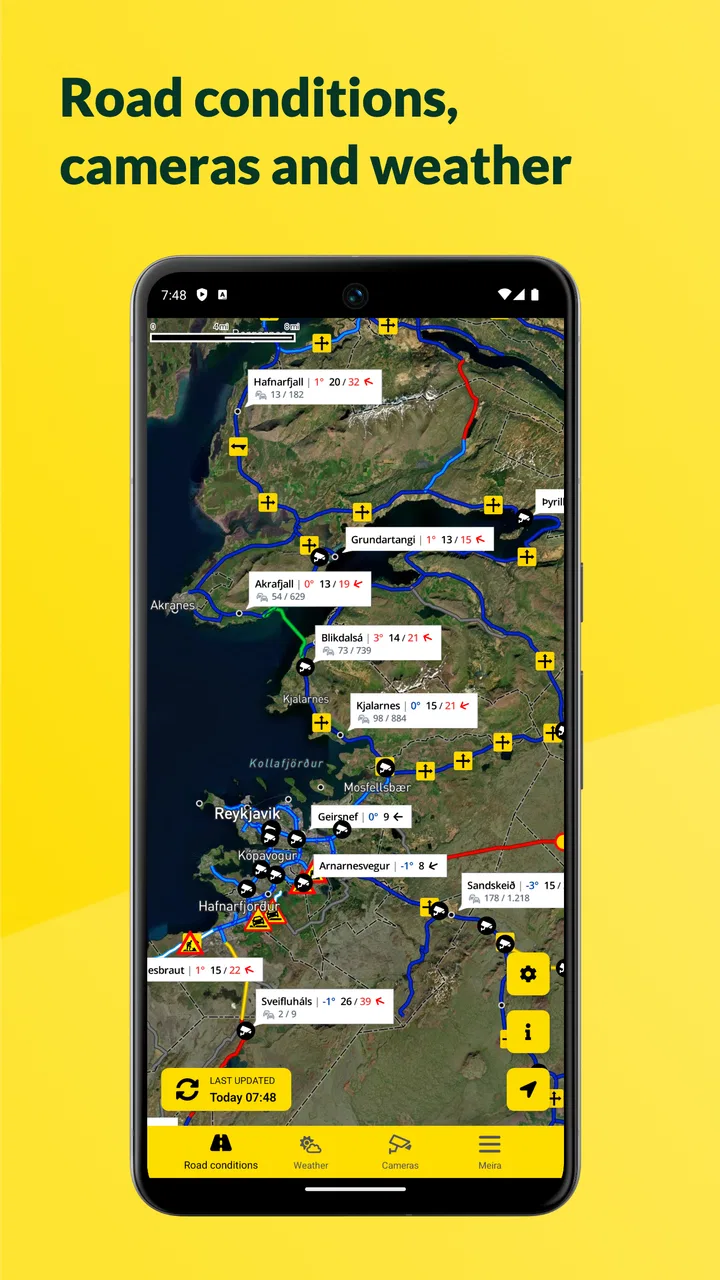
When I need to judge whether an Icelandic road trip is sensible, a normal weather app is only part of the answer. Wind, snow, changing visibility, and the condition of the road itself can matter more than the temperature on my screen. That is where Færð & Veður makes sense: it is a focused weather app for Iceland that puts road and weather conditions at the center rather than treating driving information as an afterthought.
My overall view is straightforward: this is a useful companion for people who drive around Iceland, especially when a route crosses exposed areas or rural roads. It is not the kind of app I would install as my only source for every weather question, and it does not replace sensible decisions, local notices, or checking conditions shortly before departure. Still, its narrow purpose is also its main strength. Instead of trying to be a worldwide weather dashboard, it concentrates on the information that can change a journey from comfortable to unpleasant, or from merely slow to genuinely unsafe.
Why a road-focused Iceland weather app is useful
The first thing I noticed about the concept is how practical it is. A general forecast may tell me that a place is cold or windy, but that does not automatically explain what the drive will feel like. A road-focused service encourages a different habit: before leaving, I think about the route, the exposed sections, and whether the current conditions deserve a delay or a change of plan.
You May Also Like

 Pandora - Music & Podcasts
Pandora’s Music Is Easy to Start, but Harder to Recover
Pandora’s strength is its low-effort path from a seed to a station. Its weak spot is how much confidence it asks you to place in connection, setup, and quiet recovery.

 8 Ball Pool
 Is Built on Rivalries, Rematches, and Routine
A close look at the rivalries, rematches, shared routines, and unanswered safety questions that turn a quick pool match into a persistent mobile community.

 Samsung Music
’s Quiet Strength Is Playing What You Already Own
Its reach comes less from spectacle than from dependable access to a personal library. That simplicity is both the app’s strongest retention engine and its ceiling.

 AccuWeather: Weather Radar
AccuWeather Review: A Quick, Clear Forecast for Everyday Decisions
For everyday plans, the best forecast is the one you can understand quickly. AccuWeather makes rain timing, radar, and local conditions easy to act on, with a few trade-offs.

 Hill Climb Racing
Why Hill Climb Racing Still Turns Crashes Into One More Run
A tiny car, a bumpy hill and one more upgrade: Hill Climb Racing keeps resurfacing because its simple chaos makes every near-miss feel personal.

 AliExpress - Shopping App
AliExpress Makes Global Shopping Feel Personal, but Shoppers Bear the Risk
AliExpress turns a global marketplace into a pocket-sized discovery engine. Its reach is useful, its shopping loop compelling, and its trade-offs easy to miss.
More From Our News Desk
View All News


That distinction matters in Iceland because travel conditions can vary sharply between the town where I start and the road I intend to use. A forecast that looks manageable near a hotel can be less reassuring once the route climbs, reaches open ground, or moves away from sheltered buildings. Færð & Veður is most valuable when I use it as a decision-making check rather than as a quick glance at a single temperature number.
The app comes from Meðalheimur ehf., and its identity is refreshingly specific. It is not presented as a broad lifestyle app with a token weather screen. Its purpose is tied to Icelandic road and weather conditions, which makes it easier for me to understand when it belongs in my routine: before a long drive, before leaving a campsite, before heading toward a remote attraction, or whenever the weather changes faster than expected.
It is also free to install, with optional in-app purchases listed from $2.99 to $29.99 per item. That makes trying it relatively easy, particularly for a visitor who wants to see whether the information fits a planned itinerary before spending anything. I would still approach the purchase options carefully and decide whether the extra value matches my travel needs rather than assuming that paying is necessary for every user.
My most useful workflow before driving
I would not open the app only after packing the car. The better workflow is to check it at three points: while planning the day, shortly before departure, and again if the journey takes several hours. The first check helps me choose a route and set realistic expectations. The second tells me whether the morning plan still makes sense. The third is important because a forecast can become less relevant as conditions develop.
This repeated-check approach is one of the less obvious strengths of a specialized road app. It changes the question from “What is the weather today?” to “Is this particular drive still a good idea now?” That is a much more useful question for someone travelling between regions, especially when the itinerary includes roads where turning back is inconvenient.
A practical example would be a traveller leaving a guesthouse for a distant viewpoint. A basic weather app might show a tolerable forecast for the destination, leading the traveller to focus on the attraction itself. I would use Færð & Veður to think about the whole journey instead: the departure area, the connecting roads, and the possibility that road conditions are more important than the destination forecast. If the route looks doubtful, the app has already done its job by prompting a slower decision before I am committed.
Where it fits beside ordinary weather apps
I see this app as complementary to a normal weather service, not a universal replacement. A mainstream weather app is usually better when I want a broad forecast for several countries, hourly planning for a city break, or a familiar interface that covers many kinds of everyday weather questions. It may also be more convenient for comparing destinations outside Iceland.
Færð & Veður has a different advantage. Its value comes from relevance. If my main concern is whether an Icelandic road journey is sensible, a focused tool can be more useful than a polished global forecast filled with information that does not affect the drive. I would use a general app for clothing, sightseeing timing, and city plans, then use this one to add the road-condition perspective that a generic forecast may not emphasize.
That division of labour avoids a common mistake: treating one weather icon as a complete travel decision. Even when the sky looks calm where I am standing, the route can still deserve caution. A road-specific check is particularly worthwhile for visitors unfamiliar with Icelandic geography, because it encourages them to respect the journey rather than judging conditions from a hotel window.
Small habits that make the information more useful
I would keep the app available before setting off instead of relying on a screenshot taken hours earlier. A saved impression of conditions can become misleading when the day changes, so checking close to departure is more responsible than collecting a forecast once and forgetting it.
I would also compare what the app indicates with what I can actually see outside. If visibility is already poor, wind feels stronger than expected, or the road looks difficult, I would treat those observations as a reason to slow down or postpone the trip. The app helps me prepare; it does not remove the need for judgement.
Another useful habit is to check before the return journey, not only before the outward trip. Travellers often spend the day thinking about reaching an attraction and then discover that the conditions have changed by the time they head back. A road-and-weather tool is most helpful when it is part of the entire travel loop, including the route home.
For longer itineraries, I would use the app to challenge an overambitious schedule. If a plan depends on perfect timing, several remote stops, and a long drive in uncertain conditions, the information may reveal that the itinerary has too little flexibility. In that situation, the best result is not necessarily finding a faster route; it may be removing one stop and leaving more room for safe decisions.
The limitation: focus does not equal certainty
The biggest weakness is also the point that needs the most honesty: no weather or road-conditions app can guarantee that a journey will be safe. Conditions can change between checks, and a screen cannot fully communicate how tired I am, how unfamiliar the road feels, or whether my vehicle and driving experience are suitable for the situation.
That means I would not use Færð & Veður to justify driving through conditions I already consider uncomfortable. If the app looks acceptable but the road feels unsafe in person, I would trust the safer choice. Likewise, if the information looks concerning, I would not assume that a clear patch outside my accommodation cancels it out.
There is also a trade-off in choosing a specialized app. Its Icelandic focus is excellent for the right trip, but less useful if I want one application to organize weather across multiple countries or a long international holiday. Someone who mainly needs pollen information, detailed climate comparisons, or a broad collection of global forecasts may prefer a more general alternative. This app earns its place through local relevance, not through trying to cover every weather use case.
The free entry point is helpful, but the presence of optional purchases means I would pay attention to what I actually need before buying. A traveller taking one short trip may be satisfied with the free experience, while a frequent driver or someone planning extensive travel may see more value in paid options. I would make that decision based on repeated use, not on the assumption that a purchase automatically makes a cautious plan safe.
Who should install it
I would recommend it most strongly to people who expect to drive in Iceland rather than remain in one urban area. That includes visitors with a multi-stop itinerary, residents who regularly travel between communities, photographers heading toward exposed locations, and anyone whose plans depend on reaching a destination by road.
It is especially suitable for travellers who prefer to make decisions in advance. If I want to know whether I should leave earlier, wait, shorten the route, or keep an alternative day available, a focused road-and-weather app is more relevant than a simple forecast widget. It supports planning without pretending that planning can control the weather.
The app should also appeal to cautious drivers who are unfamiliar with Iceland. A visitor may be comfortable driving at home but still need a different mindset when facing unfamiliar road surfaces, open landscapes, changing visibility, and long distances between convenient stopping points. The app cannot teach all of that, but it can encourage the right pre-drive question: what are the conditions along the route, not just at the starting point?
I would be less enthusiastic about recommending it to someone who never drives and only wants a general forecast for a city holiday. That person may find a conventional weather app simpler and more useful. I would also suggest looking elsewhere if the main requirement is a worldwide weather tool with a large collection of unrelated forecasting features. Færð & Veður is strongest when its specific Icelandic road context is directly relevant.
What the public response suggests
The app has an average rating of 4.8 from around one thousand ratings, and it has passed fifty thousand installs. Those figures suggest that it has found a clear audience among people who value its focused purpose. I would treat that reception as encouraging rather than conclusive: a high rating can show that the app meets its intended need, but it does not mean every traveller will prefer its approach to a familiar general-purpose service.
Its Everyone age classification also makes it straightforward to consider for a household trip. In practice, the important question is not age but responsibility. A younger passenger might look at the conditions, yet the driver still needs to make the final decision based on the full situation, including visibility, experience, vehicle suitability, and fatigue.
The app was released on January 3, 2022, and the current version is 2.0.0. It supports devices running Android 7.0 or later, which gives it a reasonably broad technical reach for Android users. I would still check compatibility before a trip and install or update it while I have reliable internet, rather than waiting until I am already travelling through an area with limited connectivity.
My verdict for an Iceland road trip
After looking at how I would actually use it, I see Færð & Veður as a practical specialist rather than a complete weather replacement. Its strongest contribution is simple but important: it puts road conditions into the same decision as the forecast. That is exactly the perspective I want when a day’s plan depends on driving through changing Icelandic weather.
I would install it before an Iceland road journey, use it alongside a general forecast, and check it again before returning from a remote stop. I would not use it as permission to take risks, and I would not expect it to satisfy every weather need outside Iceland. Those limits do not undermine its purpose; they define it.
My recommendation is clear: choose it if road travel in Iceland is central to your plans, and skip it if you only need a broad everyday weather app. For the right user, its focused approach can lead to better timing, more flexible itineraries, and fewer decisions made from incomplete information. That makes it a worthwhile free addition to an Iceland travel setup, provided I remember that the safest forecast is always the one combined with patience and good judgement.
FAQs for Færð & Veður - Road conditions
01What is Færð & Veður - Road conditions used for?
Færð & Veður - Road conditions is designed to help drivers check current road conditions and weather information before and during a journey. It can provide useful details about slippery roads, snow, wind, visibility, closures, and other hazards. The app is especially helpful in Iceland, where weather can change quickly and driving conditions may become difficult with little warning.
02Does the app provide live road condition and weather updates?
The app is intended to display current or recently updated information from relevant road and weather services, helping users make better travel decisions. However, conditions can change faster than the information is refreshed, particularly during storms or heavy snowfall. Always check the update time, compare information with official sources, and avoid relying on the app alone when conditions appear dangerous.
03Does Færð & Veður work without an internet connection?
An internet connection is generally required to load the latest road conditions, weather reports, maps, warnings, and other live information. Some previously viewed content may remain temporarily available through your device’s cache, but it should not be considered reliable offline data. If you are traveling through areas with limited coverage, check the route before leaving and prepare an alternative source of information.
04Is Færð & Veður suitable for tourists and drivers unfamiliar with Icelandic roads?
Yes, the app can be useful for visitors, rental-car users, and anyone unfamiliar with Iceland’s rapidly changing driving environment. It may help you understand whether a route is open, difficult, icy, snowy, or affected by strong winds. Nevertheless, users should also follow local traffic signs, rental-car guidance, official travel advice, and road restrictions, especially when driving in winter or remote areas.
05Can I safely rely on the app when planning a long trip?
The app is a valuable planning aid, but it should not be treated as a guarantee that a road will remain safe throughout your journey. Weather and road conditions may deteriorate suddenly, and reports may not reflect the latest local situation. Before departing, review official alerts, check forecasts along the entire route, keep your phone charged, and be prepared to postpone or change your plans.
Pros
- Provides useful road-condition updates for safer travel planning.
- Weather information helps drivers prepare for changing conditions.
- Simple interface makes key travel details quick to find.
- Helpful for checking conditions before rural or long-distance trips.
- Can support better decisions during winter driving and poor weather.
Cons
- Coverage and accuracy may vary by location and reporting source.
- Some information may be delayed during rapidly changing conditions.
- Requires an internet connection for current updates.
- Limited usefulness outside the regions supported by the service.
- Weather forecasts cannot replace official warnings or careful driving.

Færð & Veður - Road conditions
Gallery